
 Blog
Blog
Nobody searching for golfer's elbow in the middle of the season wants to be told to rest for six weeks. So let us start with the part that matters: for most golfers, complete rest is neither necessary nor the fastest route back. What is necessary is taking load off the tissue that is irritated, and then working out why that tissue was carrying so much load in the first place.
That second part is where most golfer's elbow treatment stops short. The elbow is almost never the reason the elbow hurts.
The Short Version
| What | Where it hurts | What is usually behind it |
|---|---|---|
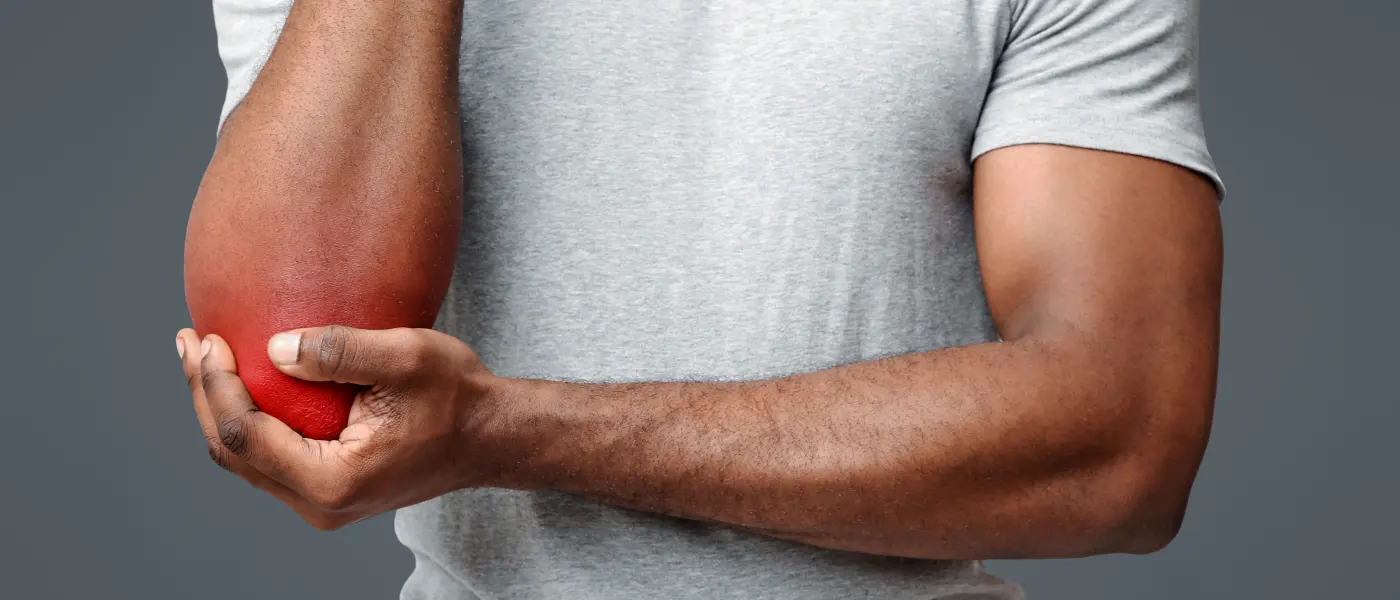
| Golfer's elbow (medial epicondylitis) | Inside of the elbow, the bony bump on the pinky side | Overload of the wrist flexor and pronator tendons, usually from gripping, deceleration, and fat shots |
| Tennis elbow (lateral epicondylitis) | Outside of the elbow, the bony bump on the thumb side | Overload of the wrist extensor tendons. Golfers get this too, usually in the lead arm |
| Golf back pain | Low back, often on one side, worse after a round or a range session | Rotation demand landing on the lumbar spine because the hips and mid back are not rotating |
If the tender spot is on the inside of your elbow and it lights up when you grip a club, shake a hand, or lift a full coffee cup with the palm up, you are almost certainly looking at golfer's elbow.
What Golfer's Elbow Is, and What It Is Not
Golfer's elbow is an overload injury of the tendons that attach to the inside of your elbow, the ones that flex your wrist and rotate your forearm palm down. The old name, medial epicondylitis, ends in "itis", which implies inflammation. In practice most persistent cases are less about active inflammation and more about a tendon that has been loaded faster than it could adapt, and has changed in quality as a result. That distinction matters, because it explains why anti inflammatory measures alone tend to give temporary relief and why progressive loading is what actually resolves it.
It is not a joint problem, it is not arthritis, and in the vast majority of cases it is not a tear. It is a capacity problem: demand went up, tolerance did not.
Two things reliably drive that demand up in a golf swing. The first is grip. A tight, anxious grip, or a grip that has to fight the club because the swing arrives out of sequence, loads those tendons every single repetition. The second is deceleration, particularly fat shots and range sessions off firm mats, where the club is stopped abruptly and the forearm absorbs it.
Why It Is Usually Not the Elbow's Fault
Here is the part almost nobody tells you.
The golf swing needs rotation. A lot of it, generated quickly, and mostly from the hips and the thoracic spine, the mid back region behind your ribcage. When those two areas rotate well, the arms are along for the ride and the club is delivered by the body.
When they do not rotate well, the swing still has to happen. The rotation has to come from somewhere, so the arms and hands start doing work that the body should be doing. The forearms grip harder, the wrists do more, and the elbow becomes the place where the compensation lands. That is why golfer's elbow so often shows up in players who have not changed anything about their practice volume, and why it so often comes back after being "rested" successfully.
This is exactly the relationship the TPI framework is built around, and it is what our golf assessment looks for. Restricted hip internal rotation, a stiff thoracic spine, or tight lats and hip flexors show up as recognisable swing faults: early extension, loss of posture, reverse spine angle. The same restrictions also show up as pain, in the low back, the shoulder, or the elbow. Same root cause, two different symptoms.
Which means treating the elbow and sending you back to the same body is a short term fix.
What to Do in the First Two Weeks
The goal for the first two weeks is not zero load. It is tolerable load.
Modify, do not stop. Most golfers with medial elbow pain can keep playing in some form. What usually needs to change is the range session, not the round. Hitting two hundred balls off a firm mat is far more provocative than playing eighteen holes.
Get off the mats. If you have access to grass, use it. Mats punish fat shots and fat shots punish the medial elbow.
Fix the grip pressure. A conscious reduction in grip tension is the single cheapest intervention available and it is often worth more than any brace.
Check the grips themselves. Worn, slick, or undersized grips make you hold on harder. This is a genuinely common and genuinely fixable contributor.
Warm the forearm up before you play, rather than stretching it aggressively after it already hurts.
Use pain as a guide, not a wall. Discomfort during a session that settles within 24 hours is usually acceptable. Pain that is worse the next morning than it was the previous evening means the last session was too much. That 24 hour rule is more useful than any pain scale.
Ice or a topical anti inflammatory for symptom control if you want it. It buys comfort. It does not build tolerance.
What to avoid: heavy gripping work at the gym while it is irritable, aggressive deep stretching of the forearm flexors into pain, and cortisone as a first resort. Injections can settle a bad flare, but they do not address capacity, and repeated injections into a tendon are not a strategy.
The Mobility That Takes Load Off the Elbow
This is the work that changes the picture. All of it is aimed at giving the swing somewhere else to get its rotation from.
| Movement | What it unlocks | Dose | When |
|---|---|---|---|
| 90/90 hip internal rotation drill | Trail hip rotation in the backswing | 2 sets of 8 per side, slow | Daily |
| Seated or side lying thoracic rotation | Mid back rotation, the biggest single limiter | 2 sets of 8 per side | Daily |
| Half kneeling hip flexor and lat stretch | Lead hip extension and overhead position | 2 sets of 30 seconds per side | Daily |
| Wrist flexor and pronator mobility, gentle range only | Forearm tissue tolerance without provoking it | 2 sets of 10, pain free range | Daily, gentle |
| Standing rotational warm up with a club | Sequencing before you hit the first ball | 1 set, 10 each direction | Before every round or range |
Two notes on that table. First, the hip and thoracic work is the priority, not the forearm work, even though the forearm is what hurts. Second, "pain free range" on the wrist work is not a suggestion. Aggressively stretching an irritated flexor tendon is a reliable way to extend your recovery by a month.
Building Capacity So It Does Not Recur
Tendons are built, not rested, into tolerance. Once the acute irritability has settled, the elbow needs progressive loading, and this is the phase people skip because by then it no longer hurts.
The principle is simple: load the tissue in a controlled way, slightly more over time, until its tolerance exceeds what golf demands of it. In practice that means graded wrist flexion and forearm rotation work, and grip strength work, progressed slowly, with slow controlled tempo rather than speed. Discomfort during the work is normal. Pain that lingers into the next day is the signal to back off a step.
Alongside that, the rotational capacity work continues. Mobility gets you the range. Strength is what lets you use it under load at swing speed. A hip that can rotate on a mat but not during a downswing has not solved the problem, which is why our care combines the movement work with actual strength training rather than handing you a stretch sheet.
Golf Back Pain, the Other Common Complaint
Low back pain is the most common complaint in golf, and it comes from the same place as the elbow problem.
The golf swing requires the pelvis and the ribcage to separate and rotate on each other, at speed, repeatedly. If the trail hip cannot internally rotate in the backswing and the thoracic spine cannot rotate to complete it, the lumbar spine, which is not built for much rotation, is left to make up the difference. Add the compression of a hard, fast rotation with side bend at impact and the low back is doing a job it is not designed for.
The tells are recognisable. Pain on one side, usually the trail side, that arrives during or after a round rather than during a swing. Stiffness getting out of the cart. A range session hurting more than a round. And the swing faults themselves: early extension, where the hips push toward the ball because they cannot rotate; loss of posture; reverse spine angle.
Treating the low back alone has the same problem as treating the elbow alone. The pain is where the load landed, not where it came from. The fix is restoring hip and thoracic rotation and then building the strength to control it, so the lumbar spine stops volunteering.
When to Get It Looked At
Most golfer's elbow settles with load management and the right mobility and strength work. Get it properly assessed if:
Get it assessed if
- It is not improving after three to four weeks of sensible modification
- There is numbness or tingling in the hand or fingers, which points at nerve involvement rather than tendon
- You have lost grip strength, for example dropping things or struggling to open a jar
- The pain wakes you at night or is present at rest
- There was a sudden pop or tearing sensation, or immediate significant swelling and bruising
- Any medial elbow pain in a junior golfer, which should always be assessed rather than managed at home, because the growth plate on the inside of a young elbow is a genuine concern
How We Work With Golfers at The Bridge
Every golfer starts with the same question: what is your body actually able to do?
Dr. Beyerl is TPI Certified, using the same physical assessment framework used by tour level medical providers. The physical screen looks at how you rotate, where the restriction actually is, and which swing faults that restriction is producing. It is not a swing lesson and it is not a substitute for one. It tells you which parts of your swing are a body problem and which parts are a technique problem, which is information your coach can immediately use.
From there, care combines hands on treatment with the movement work: soft tissue therapy for the forearm, lats, and hips using myofascial release and instrument assisted work; chiropractic adjustments to restore rotation in the thoracic spine and hips; and progressive strength and movement work so the restriction does not simply return in six weeks.
The Carlsbad office is a short drive off the 5 near Ponto Beach, which makes it the convenient one for most North County golfers. It is open Thursdays.
Frequently Asked Questions
How do you treat golfer's elbow?
Treatment has three parts. First, reduce the load on the irritated tendon without stopping golf entirely: cut range volume, get off firm mats, reduce grip pressure, and check your grips are not worn or too small. Second, restore the hip and thoracic rotation that was forcing your arms to do the body's work, which is usually the actual cause. Third, progressively load the forearm and grip so the tendon's tolerance exceeds what your swing demands. Hands on treatment, soft tissue therapy and adjustments, speeds up the first two. Rest alone addresses none of them, which is why golfer's elbow so often returns after a break.
How long does golfer's elbow take to heal?
Most cases improve meaningfully within a few weeks of sensible load management, but a tendon that has been irritated for months usually needs a few months of progressive loading to be genuinely durable. The mistake almost everyone makes is stopping at the point where it no longer hurts, which is well before the tissue has rebuilt its tolerance. That is why recurrence rates are high. If it is not improving at all after three to four weeks, get it assessed rather than waiting longer.
Can I keep playing golf with golfer's elbow?
Usually yes, with modifications. The useful test is the 24 hour rule: discomfort during a round that settles by the next morning is generally acceptable, while pain that is worse the following day means that session was too much. Cut range sessions before you cut rounds, because two hundred balls off a firm mat is far more provocative than eighteen holes. Stop and get assessed if you develop numbness, tingling, or genuine grip weakness.
Why does my lower back hurt after golf?
Usually because your hips and mid back are not rotating enough, so your lumbar spine is making up the difference. The golf swing needs the pelvis and ribcage to rotate on each other at speed, and the lower back is not built for much rotation. When the trail hip cannot internally rotate and the thoracic spine is stiff, the load lands on the lumbar spine instead. That is also why golf back pain often shows up alongside swing faults such as early extension and loss of posture. Treating the back alone rarely holds, because the rotation restriction is still there.
Find Out What Is Actually Limiting Your Swing
If your elbow or your back is the price you pay for playing, that is worth thirty minutes of your time to understand properly.
The Bridge Chiropractic
Carlsbad: 6102 Avenida Encinas, Suite H, Carlsbad, CA 92011
Thursdays 10 AM to 6 PM
Start with a free discovery call
20 to 30 minutes on the phone with Dr. Beyerl, to talk through what is going on and whether a golf screen is the right next step. No commitment.
Book a Free Discovery Call